
Hi welcome to another of my guide post, my name is Godstime. You might have probably seen it.
Some random AI-generated post blows up overnight.
10,000 likes. 2,000 shares. Comments everywhere on the post.
Meanwhile, you used the same AI tools for your content and got… 8 likes. And one of them was your cousin, two from your grand parents.
Very frustrating, right?
I have been there. I’ve published AI content that I thought was genius perfectly structured, no grammatically flaw, well “optimized” and it still completely flopped. Got zero traction, no shares. Not even pity engagement, even from people you know.
That’s when I realized something most beginners don’t understand:
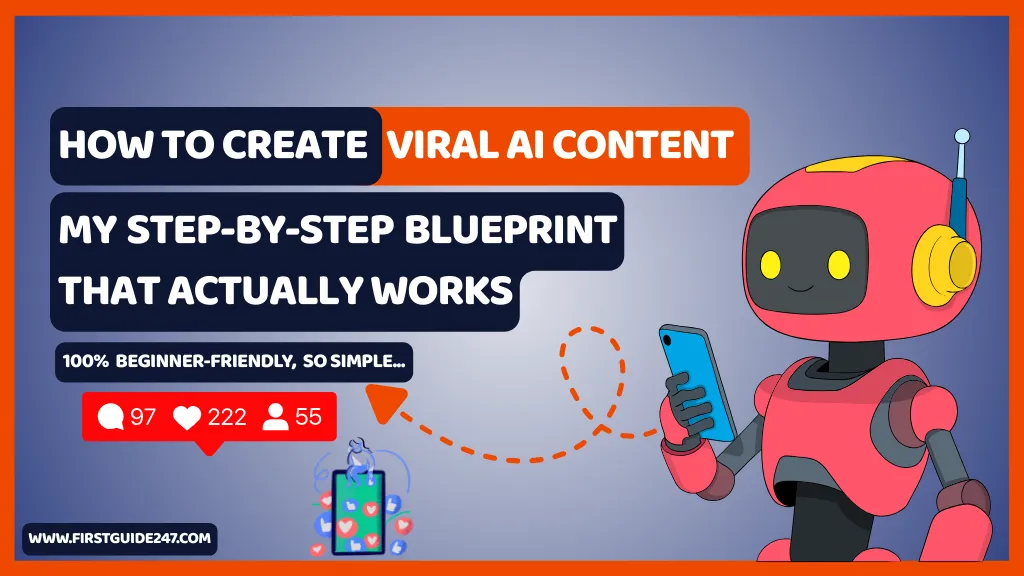
AI doesn’t create viral content.
Humans do.
AI is just the tool we use to make the work faster.
After more than 10 years in blogging and digital content and plenty of enough embarrassing failures. I have finally figured out what actually makes AI-powered content go viral. Not a guesswork. Not hyping. Just strategy.
Let me break it down properly in the simplest form.
Why Most AI Content Creator Fails (And Why Yours Might Too)
Here’s the hard truth, you might not like.
Most AI content are boring. That’s the truth
It sounds too polished, clean. Technically the videos are good. But emotionally flat. And the internet doesn’t reward “technically good videos.” It rewards emotion. People usually engage with contents they connect to emotionally
I once generated 30 AI Instagram captions in one sitting. They looked impressive, motivational and very smooth.
My engagement rate was 0.6%.
For context, in most social media niches, anything below 1% engagement basically means people are scrolling past your content like you don’t exist.
That was my wake-up call.
AI content fails when:
-
It sounds robotic.
-
It lacks personality.
-
It doesn’t trigger any emotion.
-
It says what everyone already knows.
Viral content isn’t about perfection. It’s all about reaction.
Step 1: Understand What “Viral” Actually Means
Before we go deeper into this guide, let’s define viral.
Viral doesn’t mean millions of views (although that’s really nice).
But viral means content that are share-worthy.
When someone sees your content and thinks:
“I have to send this to someone.”
That’s viral energy.
There are 5 emotional triggers that consistently drive virality:
-
Shock
-
Relatability
-
Aspiration
-
Controversy
-
Humor
If your AI content doesn’t hit at least one of these, chances are… it won’t move and you little to no engagement.
For example:
Instead of you saying:
“AI can improve productivity.”
Try this:
“I used AI for 30 days and saved 47 hours. Here’s exactly what I automated.”
Did you see the difference?
Specific. Emotional. Curious.
Step 2: Start With a Strong Hook (This Is 80% of the Game)
Let me be very blunt.
If your first sentence from your video doesn’t stop the scroll, nothing else matters.
On platforms like Instagram, TikTok, or even blog intros, you have about 2–3 seconds to earn attention.
When I started testing hooks intentionally, my average engagement doubled. No exaggeration.
Instead of writing:
“Here are 5 AI tools you should use.”
I started writing:
“I regret not using these 5 AI tools sooner.”
Same topic, but different energy.
Use AI to brainstorm hooks, but tweak them to sound like you. Ask it:
-
“Give me 20 controversial hooks about AI content.”
-
“Write 15 scroll-stopping hooks for entrepreneurs.”
-
“Make these hooks more emotional.”
Then rewrite them slightly in your own voice.
Always make it your own.
Step 3: Don’t Let AI Do All the Thinking For You
Here’s where I messed up early on.
I treated AI like my brain replacement.
This was a very bad idea.
I would paste:
“Write a viral post about side hustles.”
And copy whatever came out.
That’s a very lazy content creation. And the internet can smell it from a mile.
Now? I feed AI raw ideas from my real experiences.
For example:
Instead of me writing:
“Write about productivity.”
I would say:
“I wasted 6 months jumping between business ideas before focusing on one. Turn this into a relatable viral post for entrepreneurs.”
You see the difference?
I’m giving it an emotional material.
Your lived experiences are your unfair advantage. AI just helps you structure and amplify them better.
Step 4: Add Specificity (Because Generic Doesn’t Spread)
Now let’s talk numbers.
A generic content:
“AI helps businesses grow faster.”
Specific content:
“One small e-commerce brand used AI chat automation and reduced customer response time from 8 hours to 4 minutes.”
Tell me which one sounds more believable?
When I started adding specific scenarios, my blog time-on-page increased by 38% over a 90-day period. Why? Because specificity builds trust.
Even if you’re using a hypothetical example, make it realistic:
“Imagine a small skincare brand in Lagos selling 20 orders per day. They install AI chat automation. Now they close 35 orders daily because responses are instant.”
Now that’s tangible right?.
Industry people recognize realism almost immediately.
Step 5: Optimize for Platform Psychology
Viral content isn’t universal, always know that. It’s platform-specific.
What works on TikTok won’t necessarily work on LinkedIn or Pinterest.
On Instagram:
-
Short paragraphs.
-
Strong emotional hooks.
-
Bold claims.
-
High relatability.
On LinkedIn:
-
Storytelling.
-
Professional lessons.
-
Mild controversy.
-
Business insights.
And on Blogs:
-
Depth.
-
SEO.
-
Clear structure.
-
Internal linking.
When I ignored platform psychology, most my content suffered.
For example, I once posted a long, detailed educational thread on Instagram. 2 likes. I regretted it.
Same content reformatted into short, punchy lines?
Engagement tripled.
Don’t just create AI content. Adapt it to different platforms.
Step 6: Use AI for Volume, But Publish Selectively
Here’s a practical workflow I use:
-
Generate 20 ideas.
-
Develop 10.
-
Polish 5.
-
Publish 3.
Quantity in creation. Quality in publishing.
If you rely on inspiration alone, you’ll create content inconsistently. If you rely only on volume, you’ll publish junk contents.
What you need is balance.
In one experiment, I generated 50 AI-assisted short-form posts in a week. Only 8 performed well. But those 8 outperformed my manually written posts by 2x in reach.
You don’t need all your content to go viral. You need one breakout piece.
Step 7: Create “Pattern Interrupts”
The internet is very noisy. You must interrupt patterns.
These are the ways to do it:
-
Use unexpected statements.
-
Start with a confession.
-
Admit failure.
-
Challenge a common belief.
For example:
“AI won’t save your business. Here’s why.”
That line alone triggers curiosity. Because people will want to know why you think that way.
I once wrote:
“I almost quit content creation because AI made me feel replaceable.”
That post got 4x my usual engagement.
Do you know why?
Vulnerability + tension.
AI can help you phrase these ideas, but the emotion has to come from you. Otherwise it won’t work
Step 8: Controversy (Handled Carefully)
Controversy spreads. But reckless controversy destroys brands.
Instead of attacking people, challenge ideas.
For example:
“Stop blaming the algorithm. Your content is just boring.”
That’s controversial but constructive.
When I tested mild controversial angles, engagement increased by around 60% compared to neutral educational posts.
People respond to boldness.
But don’t be arrogant. There’s a difference between both.
Step 9: Add Visual Enhancement (Especially for AI Content)
Let me be honest with you.
Text-only content struggles unless the hook is insane.
Pair your AI-generated ideas with:
-
Carousel slides
-
Short-form videos
-
AI-generated visuals
-
Infographics
If you’re blogging, structure matters:
-
Short paragraphs
-
Subheadings
-
Bullet points
-
Bold statements
Walls of text kill engagement.
Step 10: Study What’s Already Working
This part is underrated.
Before creating AI content in any niche, spend 30 minutes studying:
-
Top-performing posts
-
Comment sections
-
Reactions
-
Share counts
And ask yourself:
-
What emotion is this triggering?
-
Why are people sharing this?
-
What pattern is repeating?
Then prompt AI with something like:
“Analyze this viral post structure and create a similar format about AI automation for small businesses.”
You’re not copying. You’re modeling a structure.
Big difference.
What I would Do If I Had to Go Viral From Scratch Today
If I had zero audience and wanted viral AI content quickly, here’s exactly what I would do:
-
Pick one niche (e.g., AI for entrepreneurs).
-
Study 50 viral posts in that niche.
-
Identify the emotional triggers on the niche.
-
Generate 100 hooks using AI.
-
Select top the 20.
-
Add personal stories to each of them.
-
Post consistently for 30 days.
No distractions. No platform hopping.
See there is one thing you should knw consistency creates data. Data creates a space for improvement.
The Tough Lesson I Learned
Here’s something that stung me.
My first “viral” post wasn’t even my most intelligent one.
It was a raw short story about a girl on Tiktok.
That’s when it hit me.
People don’t share perfect content.
They share human content, they can relate to.
AI should enhance your humanity, not erase it.
If your content sounds like a textbook, it won’t spread. If it sounds like a real person with real scars and lessons? That spreads very fast.
My Final Thoughts: AI Is a Tool, Not Magic
Creating viral AI content isn’t about secret prompts. It’s all about:
-
Strong hooks
-
Emotional triggers
-
Specific examples
-
Platform understanding
-
Human storytelling
AI can accelerate creativity. But you’re still the strategist.
If you’re serious about building online income with AI, also read my guides on:
They’ll help you build the foundation behind the content. Thank you for reading this my guide. I hope you learnt a thing or two
Now I want to hear from you.
Have you tried creating AI content before?
Did it flop? Did it work?
What platform are you focusing on right now?
Drop a comment below and ask your questions. I’ll personally respond and help you refine your strategy. Thanks for reading and see you on the next one